Open Science
-
Open Science
-
What is Open Science?
Science is a continuous search for new knowledge. It aims to discover, explain, and answer emerging questions, with old theories evolving as new evidence appears. This progress relies on the core principle of testing, updating, and refining what we know.
Open Science builds on this principle by making research transparent, accessible, and participatory. It means that not only results but also research data, lab notes, methods, and other elements of the process are shared openly, so they can be checked, reused, and improved by others. Open Science extends beyond the scientific community: it invites broader society to access and contribute, fostering collaboration and amplifying research’s impact.
Its goals include making publications, data, software, infrastructures, and even education openly available, while promoting values such as inclusion, fairness, equality, and sharing. Ultimately, Open Science changes how research is conducted, who can take part, and how it is valued. It enhances reliability, transparency, and reproducibility, while equipping students and researchers with skills that are part of good scientific practice.
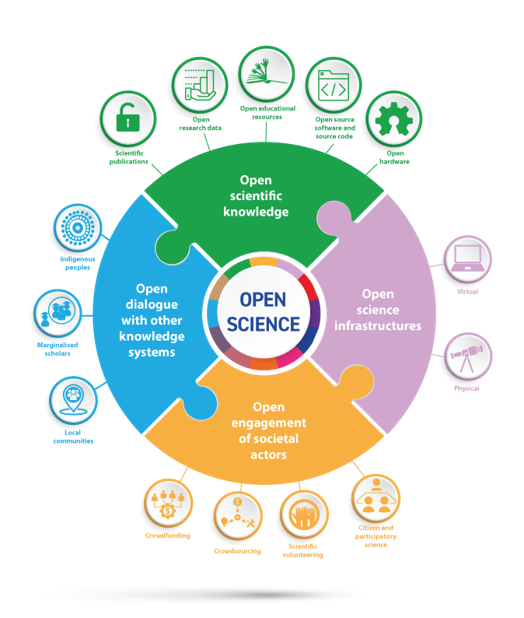
By UNESCO.org
-
ouvrirlascience. What is Open Science ? , in Passport for Open Science. [Vidéo]. Canal-U. https://www.canal-u.tv/138432.
-
Benefits of Open Science
OECD has summarized the overall arguments for supporting Open Science in the following factors:
- Improving efficiency and productivity: Open Science reduces overlapping work and lowers the costs of producing, sharing, and using knowledge. It allows data to be reused and supports researchers in participating in large, multidisciplinary national and international projects.
- Increasing transparency: When the research process and data are open, the reproducibility and reliability of scientific results improve.
- Speeding up knowledge transfer: Open publishing and access to data reduce delays in using research results and help speed up the journey from research to innovation.
- Economic benefits: A faster innovation process supports businesses and brings both commercial and national economic advantages.
- Solving global challenges: Open Science promotes international cooperation and knowledge exchange, which is essential for understanding and solving issues like climate change or population aging.
- Engaging citizens: Open Science can raise public awareness and trust in science, and also allow people to actively take part in research and data collection.
The COVID-19 pandemic highlighted the power of Open Science, even under tragic circumstances. By mid-2021, over 85% of COVID-19-related articles were openly accessible - compared to the usual 40% for academic publications - enabling rapid scientific progress and major breakthroughs in record time.
-
ouvrirlascience. Open resources to discover , in Passport for Open Science. [Vidéo]. Canal-U. https://www.canal-u.tv/138433.
-
Additional Resources :
-
[File] PASSEPORT FOR OPEN SCIENCE
-
[File] An introduction to the UNESCO Recommendation on Open Science
-
[File] UNESCO Recommendation on Open Science
-
Self-Assessment Quiz
-
[Self-assessment quiz] Open Science
-